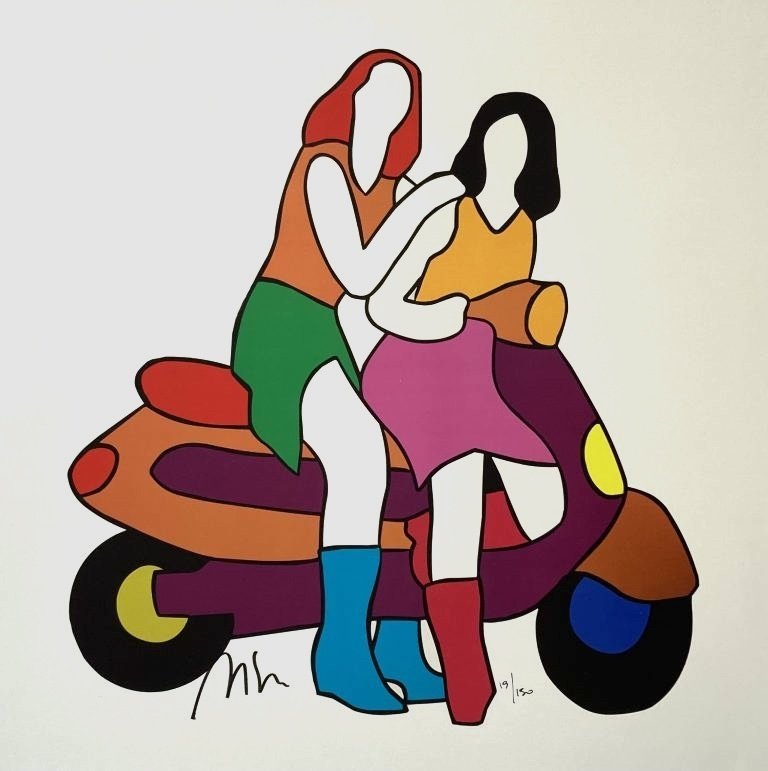
Marco Lodola was born in Dorno, in the province of Pavia, on 4 April 1955. Fascinated by the world of art from an early age, he decided to enrol first at the Academy of Fine Arts in Florence and subsequently in Milan. His earliest works date back to the 1960s and primarily depict famous figures from the international music scene, alongside influences from Pop artists such as David Hockney and Tom Wesselmann. Two decades later, Lodola became associated with the movement known as Nuovo Futurismo (New Futurism), eventually being recognised, alongside Dario Brevi, as one of its founding figures. During the 1980s, Lodola began gaining recognition both in Italy and abroad. From that moment onwards, his artistic production intensified, establishing him as one of the leading figures in contemporary Italian art. He has participated in numerous exhibitions, both throughout Italy and internationally, including shows in Beijing, Singapore, Hong Kong, and New York. Today, he is regarded as one of the most celebrated and widely appreciated contemporary Italian artists. His artistic universe is extraordinarily colourful and unmistakably rooted in Pop Art, populated by faceless figures, dancers, athletes, and musicians. It is an immaterial world composed of outlines and light, characterised by a distinctly two-dimensional visual language. Deeply immersed in contemporary culture, of which he is one of the most distinctive interpreters, Lodola addresses the same audience as cinema, television, and advertising. Through the continuous interplay between different artistic disciplines, he seeks new sources of inspiration and creative energy, striving to bring the rhythms and methods of artistic expression into harmony with those of contemporary society.
Marco Lodola was born in Dorno, in the province of Pavia, on 4 April 1955. Fascinated by the world of art from an early age, he decided to enrol first at the Academy of Fine Arts in Florence and subsequently in Milan. His earliest works date back to the 1960s and primarily depict famous figures from the international music scene, alongside influences from Pop artists such as David Hockney and Tom Wesselmann. Two decades later, Lodola became associated with the movement known as Nuovo Futurismo (New Futurism), eventually being recognised, alongside Dario Brevi, as one of its founding figures. During the 1980s, Lodola began gaining recognition both in Italy and abroad. From that moment onwards, his artistic production intensified, establishing him as one of the leading figures in contemporary Italian art. He has participated in numerous exhibitions, both throughout Italy and internationally, including shows in Beijing, Singapore, Hong Kong, and New York. Today, he is regarded as one of the most celebrated and widely appreciated contemporary Italian artists. His artistic universe is extraordinarily colourful and unmistakably rooted in Pop Art, populated by faceless figures, dancers, athletes, and musicians. It is an immaterial world composed of outlines and light, characterised by a distinctly two-dimensional visual language. Deeply immersed in contemporary culture, of which he is one of the most distinctive interpreters, Lodola addresses the same audience as cinema, television, and advertising. Through the continuous interplay between different artistic disciplines, he seeks new sources of inspiration and creative energy, striving to bring the rhythms and methods of artistic expression into harmony with those of contemporary society.