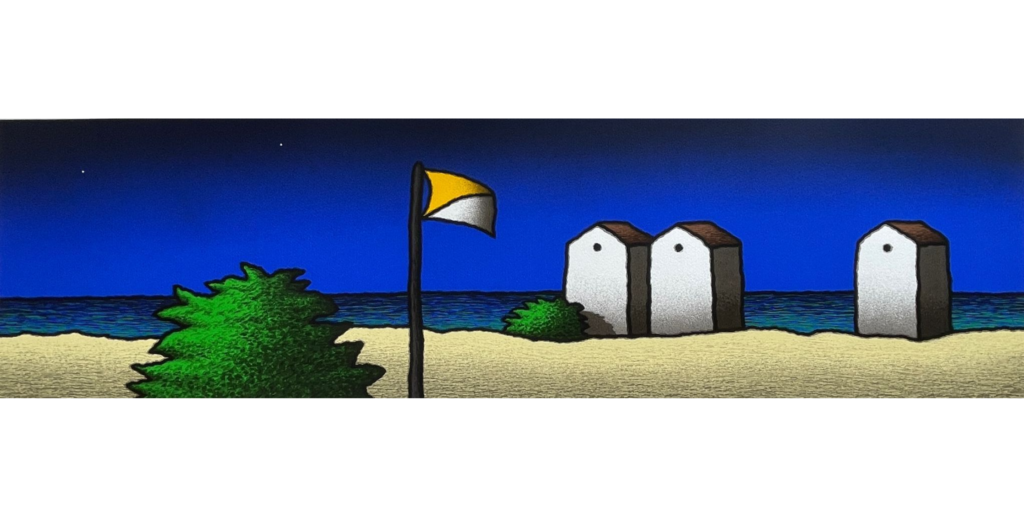
After attending the art school of the Scuola Beato Angelico, he continued his studies at the Polytechnic University of Milan. In 1967, he received his first major recognition, winning the San Fedele Prize, awarded to young paintersIn 1968, he held his first solo exhibition at the Galleria Apollinaire in Milan, accompanied by an essay by Pierre Restany. In 1970, he was invited to participate in the Experimental Pavilion of the 35th Venice International Art Biennale. Da allora, le sue opere sono state esposte in numerose gallerie, musei e spazi pubblici. His earliest works consisted of white relief surfaces, expressions of conceptual minimalism inspired by the artistic atmosphere of Milan at the time. The artist described them as "soap bubbles", emphasising their distinctive combination of reality and imagination. He depicted simple, everyday objects — shirts, pencils, pliers, tubes of paint, and pens — isolating them in space and reducing them to icons. In doing so, he rendered them motionless, contemplating them with a sense of philosophical wonder. He participated in the artistic climate of the 1980s, engaging with the practice of quotation and historical reference without adopting a detached or impersonal approach. Instead, he brought evocations and memories into his painting, establishing a dialogue with the art of the past through irony and emotion. His simplified landscapes, metaphysical explorations that are simultaneously real and imagined, follow the path established by Carlo Carrà, while eliminating every trace of realism. The most recent phase of his artistic production is characterised by sinopie — preparatory drawings reminiscent of those traditionally used in fresco painting — in which colour is almost entirely eliminated in favour of predominantly white palettes. His artistic approach is fundamentally conceptual, conceiving painting as an object of contemplation for the mind.